
Mangrove restoration for climate action

Written by Lauren Ackermans (Geographer with a heart for marine restoration)

Mangrove forests are among the most effective carbon sinks, storing vast amounts of blue carbon while protecting coastlines and supporting biodiversity. In this article, we explain how this works and how companies can leverage their sustainability strategy using mangroves’ carbon sequestration capacity.

What are mangroves?

Mangroves are distinctive trees and shrubs that thrive along coasts and estuaries. They are easily recognizable by their dense network of aerial roots, which often make them appear as if they are standing on water. These unique structures are just one of many adaptations that allow mangroves to survive in harsh tidal environments with salty and oxygen-poor soils. To cope with these low oxygen levels in the soil, mangroves have developed breathing roots (pneumatophores), which enable them to take in oxygen even when submerged. In addition, most species possess salt glands that actively expel excess salt absorbed from the surrounding water.

Image 1: Mangrove forest with pneumatophores

Mangroves occur in tropical and subtropical regions, as they cannot withstand freezing temperatures. There are approximately 80 different species of mangroves worldwide. Although they cover less than one percent of the world’s tropical forests, mangroves provide a wide array of essential ecosystem services. They support human livelihoods by supplying food, timber, fisheries, medicines, ecotourism, and clean water. In addition, mangroves offer a habitat for over 1,500 species, including many of commercial importance, and help maintain the health of nearby coral reefs and seagrass ecosystems. They also serve as natural coastal protectors, buffering storms and reducing the impact of flooding by slowing water flow, breaking waves, and stabilizing coastal sediments. A 2024 study concluded that mangroves provide approximately $855 billion worth of flood protection worldwide.

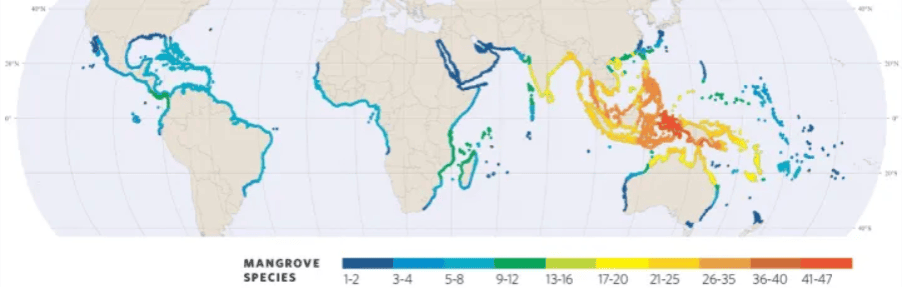
Figure: The distribution and number of mangrove species worldwide (Source: Deltares, 2014)

Blue carbon

Mangrove forests play a crucial role in climate regulation by absorbing and storing carbon from the atmosphere. As they grow, mangroves take up carbon dioxide and convert it into organic carbon, which is incorporated into their leaves, roots, and branches. When these parts die, they settle on the seabed, where the carbon becomes ‘buried’ in the soil, a process known as ‘blue carbon’ in coastal ecosystems. The low-oxygen conditions in these environments slow the decomposition of plant material, allowing mangroves to store substantial amounts of carbon over long periods. In fact, mangroves are estimated to be responsible for 8-15 percent of carbon storage in marine sediments worldwide. Through this process, mangroves act as significant net carbon sinks, contributing to the mitigation of climate change by removing carbon dioxide from the atmosphere.

Mangroves at risk

Recently, mangrove ecosystems have been increasingly threatened by both natural and human activities, including urbanization, pollution, aquaculture, and tourism, all of which disrupt the functioning of their essential ecosystem services. The loss and degradation of mangrove forests result in significant greenhouse gas emissions, primarily through deforestation, drainage, or soil disturbance. When the carbon stored in plants and sediments is exposed to oxygen, microorganisms break down the organic material, releasing the captured carbon as carbon dioxide (CO₂) and, in some cases, methane (CH₄), both of which contribute to climate change.

Despite their crucial role in carbon storage and the wide range of goods and services they provide to humanity, mangrove ecosystems are declining at an alarming rate, necessitating urgent action. Emissions from mangrove loss are estimated to cause billions of dollars in economic damage each year. Protecting and restoring mangrove forests is therefore vital as a strategy for both climate change mitigation and adaptation.

Image 2: Mangrove forest

Go Oce... Go Mangroves!

Go Ocean offers opportunities to invest in blue carbon through mangrove restoration projects. Individuals can purchase a mangrove tree or a number of square meters of mangrove forest, contributing to the restoration of coastal ecosystems in places such as Madagascar. For companies, business packages are available to support projects that generate validated blue carbon credits, combined with sustainable development and biodiversity protection.

By supporting mangrove restoration, investors can directly participate in carbon offsetting while generating verified blue carbon credits. These projects not only remove CO₂ from the atmosphere by storing it in mangrove soil and biomass, but also provide a measurable way for companies and individuals to offset their emissions. Investing in blue carbon projects through Go Ocean is a practical and impactful strategy to contribute to climate change mitigation while simultaneously enhancing the resilience of coastal ecosystems and communities.

Written by Lauren Ackermans 

“I am a geographer driven by a strong passion for marine restoration. Ready to make a difference, I support Go Ocean in their mission to protect and restore our oceans and marine ecosystems.”

Sources:

Choudhary, B., Dhar, V., & Pawase, A. S. (2024). Blue carbon and the role of mangroves in carbon sequestration: Its mechanisms, estimation, human impacts and conservation strategies for economic incentives. Journal of Sea Research, 199, 102504.

Coastal Blue Carbon

IUCN – Issues Brief, 2017. Blue Carbon, November 2017 Blue Carbon – IUCN Issues Brief. Available at: blue_carbon_issues_brief.pdf

Mangrove forests | UNEP – UN Environment Programme

Mangroves | Smithsonian Ocean

What is a “mangrove” forest?

Found this article interesting? Spread the word.